
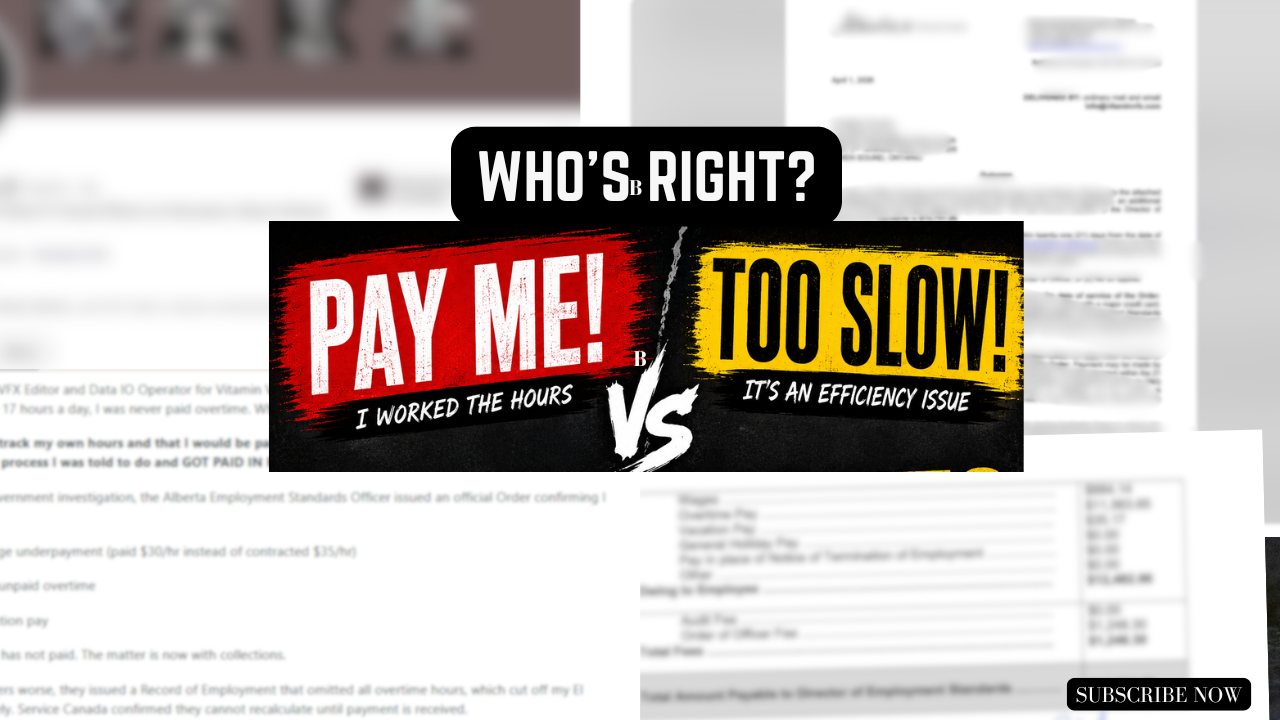
The visual effects industry has never been a stranger to overtime discussions.
Recently, another debate surfaced online around unpaid overtime in VFX, and as expected, the reactions were divided. Some artists argued that if someone worked extra hours, they should be compensated. Others questioned whether all overtime is actually caused by unreasonable workloads, suggesting that efficiency and performance should also be part of the conversation.
At first glance, this seems like a simple issue. However, the more you examine it, the more complicated it becomes.
The truth is that overtime in VFX exists in one of the industry’s largest grey areas.
The Artist’s Perspective: Time Has Value
Imagine it’s Friday evening.
A delivery is due on Monday. The client has sent another round of notes. The deadline hasn’t moved, but the workload has increased.
The artist stays late.
Maybe until 10 PM.
Maybe until midnight.
Maybe through the weekend.
From the artist’s perspective, the argument is straightforward:
“I worked those hours.”
It’s difficult to argue against that logic. Time is one of the most valuable resources anyone has. When artists sacrifice evenings, weekends, and family time to complete work, it’s natural for them to expect compensation.
Many artists also point out that they rarely control the factors that create overtime in the first place.
They don’t set schedules.
They don’t negotiate budgets.
They don’t approve bids.
They don’t determine client expectations.
Yet they often absorb the consequences when those decisions go wrong.
Projects become underbid. Clients request additional revisions. Schedules become unrealistic. The burden frequently falls on artists to bridge the gap through extra hours.
From this perspective, overtime compensation seems entirely justified.
The Employer’s Perspective: Should Performance Matter?
The discussion becomes more uncomfortable when viewed from the other side.
Imagine two compositors receive the same shot.
They have the same deadline, the same resources, and the same brief.
One artist finishes at 6 PM.
The other stays until 11 PM.
Should the second artist automatically receive five hours of overtime pay?
Many managers would argue that the answer isn’t necessarily yes.
Their reasoning is simple: companies pay for results, not just time.
If overtime becomes automatic regardless of performance, inefficiency can become expensive. Not every overtime hour is created equal.
Sometimes overtime is caused by unrealistic workloads.
Sometimes it’s caused by skill gaps.
Sometimes it’s caused by inexperience.
Sometimes it’s caused by mistakes that require rework.
This doesn’t mean the artist is bad at their job. However, it raises a difficult question:
Should a company pay extra because an employee needed significantly more time than expected to complete the same task?
It’s not a comfortable question, but it’s a legitimate one.
The Real Problem: We’re Asking the Wrong Question
The biggest mistake both sides make is focusing on the number of hours worked.
Hours alone tell us very little.
Imagine an artist worked 20 hours of overtime this month.
What does that actually reveal?
Almost nothing.
The overtime could have been caused by:
- An underbid project
- Endless client revisions
- Poor planning
- Understaffing
- A learning curve
- Performance challenges
- Constant priority changes
Or a combination of all of them.
The overtime itself is simply a symptom.
The real story lies in understanding the cause.
A more useful question might be:
Can we accurately distinguish between overtime caused by bad planning and overtime caused by performance issues?
Why Productivity Is Difficult to Measure in VFX
This is where the VFX industry becomes unique.
In manufacturing, productivity is often easy to measure.
In creative work, it’s much harder.
Imagine two compositors.
One finishes a shot in two hours.
The other takes eight.
At first glance, the first artist appears more productive.
Case closed.
Or is it?
Maybe the second artist discovered a hidden issue that prevented future problems.
Maybe they built a more robust setup.
Maybe they solved a technical challenge nobody else noticed.
Maybe they were working on a significantly more complex version of the shot.
Maybe they spent part of their day helping teammates.
Suddenly, the comparison becomes much less obvious.
Creative work is messy.
Productivity isn’t always visible.
That’s one reason these discussions become so emotional. Neither side has complete information.
Speed and Value Are Not the Same Thing
One of the biggest misconceptions in VFX is assuming that speed automatically equals value.
Sometimes the fastest artist creates technical debt that causes problems later.
Sometimes the slowest artist prevents a disaster before it happens.
Sometimes an artist appears inefficient because they’re carrying the most difficult work on the show.
And sometimes they genuinely are struggling.
The challenge is that all of these situations can look identical from the outside.
That’s why the word “efficiency” can be misleading when discussing creative work.
Efficiency is much harder to measure than many people assume.
Who Actually Owns the Overtime?
Another question that rarely gets discussed is responsibility.
Who owns the overtime?
If a studio knowingly accepts an impossible deadline, who owns the overtime?
If a client continues adding notes without extending schedules, who owns the overtime?
If a project is understaffed, who owns the overtime?
On the other hand, if an artist consistently requires twice as much time as others working on similar tasks, who owns the overtime then?
The answer isn’t always the studio.
And it isn’t always the artist.
This is precisely why these debates never seem to reach a clear conclusion.
Overtime Is Often a Chain Reaction
In many cases, overtime isn’t caused by a single decision.
It’s caused by a chain reaction of small problems.
A bid that’s slightly too low.
A schedule that’s slightly too aggressive.
A client that’s slightly too demanding.
An artist who’s still developing their skills.
A supervisor trying to protect quality.
A production team attempting to meet delivery targets.
Individually, none of these factors may seem catastrophic.
Combined, they create overtime.
Looking for a single villain often oversimplifies the situation.
The Grey Area Nobody Wants to Admit Exists
After years of working in VFX, I’ve become less interested in assigning blame.
I’ve seen artists work late because schedules were impossible.
I’ve seen artists work late because they were struggling.
I’ve seen supervisors absorb overtime to protect their teams.
I’ve seen managers trying to balance projects that were already financially underwater.
The reality is that overtime can be a symptom of many different problems:
- Poor planning
- Unrealistic client expectations
- Understaffing
- Skill gaps
- Performance issues
- Budget limitations
The danger comes when we assume every situation is identical.
Every overtime story has context.
Without that context, we’re often judging based on incomplete information.
Conclusion
The overtime debate continues because there is rarely a simple answer.
It’s easy to ask whether overtime should be paid.
The more interesting question is why the overtime happened in the first place.
Sometimes the responsibility lies with the studio.
Sometimes it lies with the artist.
Often, it lies somewhere in between.
Perhaps that’s why this discussion keeps resurfacing throughout the VFX industry.
Not because one side is completely right.
Not because one side is completely wrong.
But because the truth usually exists in the uncomfortable space between them.
And in VFX, that grey area is often larger than we’d like to admit.